Fallaway Reverse and Slip PivotTango
This figure rotates in the Reverse direction, and after a step into Fallaway position, the woman performs a Slip, and the couple Pivots. Unimaginative enough.
|
||
Three StepFoxtrot
Also doesn't leave much to the imagination.
|
||
Kick Ball ChangeJive
"How do I count that one again?" and "What is the footwork?" summed up in the name.
|
||
Chasse from PPWaltz
pffft "PP" haha I'm in seventh grade. Anyway, a Chasse, performed starting in Promenade Position.
|
||
Promenade and Couter Promenade RunsSamba
Go jogging. Then practice these. Now tell me if they feel similar AT ALL. Still though, descriptive enough.
|
||
Reverse WaveFoxtrot
This sounds more like an attack out of a Pokémon game.
|
||
SixteenPaso Doble
Not to be confused with "The eight" or "the four". Or the waltz variant, "the three".
|
||
Hover FeatherFoxtrot
Legend of Zelda, anyone? "You have obtained the Hover Feather! Equip it to float above..." [WOW, I gotta stop playing video games so much...] {Yes, I'm aware it's the Roc's Feather in the game that allows you to "float". Get over it.}
|
||
BotafogoSamba
Oooo, some culture. Imagine dancing on a hot beach in Brazil, where the sand is cooler about an inch under the surface. You'd dig your feet into the sand on every step, or else end up with your "boots on fire" (botas de fogo).
|
||
Natural Zig Zag from PPFoxtrot
Someone's kid named this one, I'm sure.
|
||
Sur PlacePaso Doble
"In Place" - most dances, this is what you're supposed to do when you mess up. In Paso, we do it on purpose. And we even give it a name. Mostly, this one just upsets me because although yes, Paso was created in France (sur place is French), but they were trying to make it like Spanish bullfighting. WELL THAT'S HARD TO DO BECAUSE MOST MATADORS DON'T WALK IN PLACE, IN FRENCH.
|
||
WingWaltz
This figure is more like a cape to me. A Batman cape. Which I guess is supposed to look like wings. Nevermind, I just want to be Batman.
|
||
New YorkRumba
I have been to New York several times now, and no two people have addressed me by rapidly turning away from one another while holding hands (save for studio and competition time).
|
||
V6Quickstep
It's like The Sixteen, but has letters. Also, an engine block.
|
||
Mini Five StepTango
1. You only take 4 steps. Apparently, in Tango, lowering a foot counts as an additional step?
2. "Mini"? Really? We can't just give it its own name?
|
||
CucarachasRumba
What romantic dance would be complete without stomping out some cockroaches?
|
||
CatapultJive
As if Jive wasn't already wild enough, let's let the girl know that we are INTENTIONALLY going to fling her about, possibly launching her several hundred yards via simple machines.
|
||
FishtailQuickstep
Did someone who love cars have a lot of influence in naming the quickstep figures? V6? Fishtail? What next, "The BrakeLight?"
|
||
Hockey StickCha Cha
Oh look, the Canadians had a say in something. "This move curves a little. What else curves a little?"
|
||
Rumba CrossQuickstep
There's a heel lead. What Rumba is this?!
|
||
Turkish TowelCha Cha
Remember that scene from Disney? "Ain't never had a friend like me"? All I can think of.
|
||
The Miami SpecialJive
Not sure if this is something you would order at a burger joint, or on a pay-per-view channel.
|
||
TipsyQuickstep
Seems appropriate that this figure has a lot of sway...
|
||
The MoochJive
No, really, in ballroom? We named something that? Completely serious?
|
Wednesday, March 27, 2013
Syllabus Moves by Silliness of Name in Ascending Order
Sometimes, a figure is named for a simple play-by-play of footwork and timing. Other times, it can be a bit more...creative. Here we have a few notable examples of the normally nuanced, but occasionally silly, nomenclature of ballroom figures.


Monday, February 11, 2013
Hard Truths about Ballroom Competition
A while back, I attend a workshop by a world-renowned instructor who wished to let us competitors in on a few secrets - the things judges don't say, the things your instructors may not want you to believe, or the things that you may believe are true, but are not. Since then, I have turned a discerning ear to instructors, distinguishing the difference between opinions on style and taste versus advice on overall presentation. The message can be a bit disheartening, but a lot of it is quite intuitive.
The bottom line is, there's more to a visual art/sport than just technique, and it's important to take care of the aesthetics. Here are a few tips that I've picked up, whether through subtle suggestion, or by being drug up to the front of a workshop as an example of "what not to do".
1. Dress appropriately - Ladies, what you're wearing DOES matter. And I know that sucks. But shiny dresses in open will get you more direct visual real estate in a 90-second round. A "heavy" dress in standard sways more and demonstrates your movement, and it's easier to focus on your Latin motion when we're not worrying that you're about to pop out of your neckline. Guys, dance pants will ALWAYS look better than business slacks. Tight sleeves make better lines than fluffy. Don't wanna buy a ballroom shirt or suit yet? Go get a 1MX from Express and spend an extra $10 to get your vest fitted. Oh, and at least sharpie out that Under-Armour logo until you actually buy a real shirt. Dressing like a serious dancer may not make you a serious dancer, but dressing like a slob certainly won't help convince anyone.
2. It's a visual sport - Guys - name one of the top 6 leads in any style with facial hair?
Ladies - dancing standard? And you think your hair looks cool when it's down? Well, Edita's hair looks awesome when it's down, but she still puts it up for comps.
3. Get in the way - Judges don't really get to see each other all that often. And they have inside jokes that only a select few would understand. So they want to stand together. And no, they don't want to walk around all day to find your number. Check this out:
...which, in Rumba, is not enough time for a back check, fan, and alemana. And that's assuming a normal distribution and that they're paying attention all 90 seconds. They're all packed on to one side of the room? Get on that side. Until the final, cut the other long wall short. Pick a spot where they can all see you and OWN IT. Seriously, be a little rude if you need to. A rude couple that can be seen will probably get marked more often than a nice couple that can't.
4. Smile - This is not about warm fuzzies. Judging SUCKS (or so I would imagine). It's gotta be like watching a kids' soccer game for these guys, except half of them don't even have a kid on the field. So you gotta at least let them know that someone's enjoying it. Syllabus dancers, particularly across multiple styles, you think they haven't picked a couple of favorites by hour 1 of 10? A smile can often get you an extra mark from a judge who needs another couple to call back.
5. You are not great - Until someone else writes a Wikipedia article about you or you get asked to showcase in another country, guess what? These judges aren't going to be "blown away" by you - so don't act like you will. Walk onto the floor humbly [arms down!] and don't take too long on your bows. Behave when you walk on and when you walk off. It's a sport with a culture and a pecking order - know your place.
6. They're playing music for a reason - The most professional step, if danced off-time, is a VERY BAD "holding still". If you don't intend to follow the music, you may as well take up gymnastics or martial arts. Watching someone dance off-time is like nails on a chalkboard for a seasoned dancer.
7. Knowing the move isn't the point - The reason there are more advanced steps as you get better is NOT so you can demonstrate, "Lookit! I did it without falling over!" The point is that more difficult steps allow you to demonstrate more technique in a shorter period of time, as well as a few advanced elements of technique. And oh, believe me, the judges know EXACTLY how well you know each step. Doing 5 things wrong to do 1 thing "cooler" won't help your marks. Stick to what you know well. That's not to say don't take risks, but try not to step too far out of your comfort zone [no pun intended]. Judges want to mark you - don't do something visually offensive that gives them a reason not to.
The bottom line is, there's more to a visual art/sport than just technique, and it's important to take care of the aesthetics. Here are a few tips that I've picked up, whether through subtle suggestion, or by being drug up to the front of a workshop as an example of "what not to do".
1. Dress appropriately - Ladies, what you're wearing DOES matter. And I know that sucks. But shiny dresses in open will get you more direct visual real estate in a 90-second round. A "heavy" dress in standard sways more and demonstrates your movement, and it's easier to focus on your Latin motion when we're not worrying that you're about to pop out of your neckline. Guys, dance pants will ALWAYS look better than business slacks. Tight sleeves make better lines than fluffy. Don't wanna buy a ballroom shirt or suit yet? Go get a 1MX from Express and spend an extra $10 to get your vest fitted. Oh, and at least sharpie out that Under-Armour logo until you actually buy a real shirt. Dressing like a serious dancer may not make you a serious dancer, but dressing like a slob certainly won't help convince anyone.
2. It's a visual sport - Guys - name one of the top 6 leads in any style with facial hair?
"Bryan Watson! Soul patch!"
You are not Bryan Watson. Get rid of it. Also, a haircut would be nice.Ladies - dancing standard? And you think your hair looks cool when it's down? Well, Edita's hair looks awesome when it's down, but she still puts it up for comps.
3. Get in the way - Judges don't really get to see each other all that often. And they have inside jokes that only a select few would understand. So they want to stand together. And no, they don't want to walk around all day to find your number. Check this out:
90 seconds / 12 couples = 7.5 seconds/couple
4. Smile - This is not about warm fuzzies. Judging SUCKS (or so I would imagine). It's gotta be like watching a kids' soccer game for these guys, except half of them don't even have a kid on the field. So you gotta at least let them know that someone's enjoying it. Syllabus dancers, particularly across multiple styles, you think they haven't picked a couple of favorites by hour 1 of 10? A smile can often get you an extra mark from a judge who needs another couple to call back.
5. You are not great - Until someone else writes a Wikipedia article about you or you get asked to showcase in another country, guess what? These judges aren't going to be "blown away" by you - so don't act like you will. Walk onto the floor humbly [arms down!] and don't take too long on your bows. Behave when you walk on and when you walk off. It's a sport with a culture and a pecking order - know your place.
6. They're playing music for a reason - The most professional step, if danced off-time, is a VERY BAD "holding still". If you don't intend to follow the music, you may as well take up gymnastics or martial arts. Watching someone dance off-time is like nails on a chalkboard for a seasoned dancer.
7. Knowing the move isn't the point - The reason there are more advanced steps as you get better is NOT so you can demonstrate, "Lookit! I did it without falling over!" The point is that more difficult steps allow you to demonstrate more technique in a shorter period of time, as well as a few advanced elements of technique. And oh, believe me, the judges know EXACTLY how well you know each step. Doing 5 things wrong to do 1 thing "cooler" won't help your marks. Stick to what you know well. That's not to say don't take risks, but try not to step too far out of your comfort zone [no pun intended]. Judges want to mark you - don't do something visually offensive that gives them a reason not to.
Saturday, November 24, 2012
Partnership - Teammate, Associate, Friend
As the cliché goes, "It takes two to tango." How true this is. While practicing alone maybe fun at times, ballroom is infinitely more satisfying with a partner moving across the floor. But not all partners are created equal. Some partners can be lazy and unfocused. Others can be hypersensitive and abusive. Good partnerships are built on more than just skill (although this can be important as well). Thus far, I feel as thought there are three roles a partner plays to a dancer - most partnerships have at least one or two of these (or they would never take off), and lucky is the lead or follow that can boast a partner capable of all three.
Teammate
Granted, "teammate" can somewhat serve as a catch-all, particularly after all of the inspiring sports movies we've grown up with. But I am speaking merely from a co-competitor standpoint - the who-would-I-pick-first-on-the-playground sense. In Little League Baseball, you have some teams with mixed skill sets - some are destined to become Nolan Ryans or Kobe Bryants, and some will never play a second season. But later down the road, teams form around people of comparable skill and experience. People work with other people that they believe have the talent to make them successful. This is true of competitive dancers as well.
It's a visual sport, and there's no getting around that. Who will you look good with? Who is capable of keeping up with you? Who knows the moves you are best at? Being a good physical and skill match can make a partnership really launch with some promising momentum.
Of course, it doesn't always work out that way. Sometimes, one of the partners will be vastly superior to the other. I myself have been the inferior partner more than is fair - it's a great position to be in, assuming you're willing to work hard and learn quickly. But bear in mind, you'd better close the gap soon. World-class musicians probably don't like playing in High School Bands for extended periods of time. If you are in the less-experienced position, you'd probably do well to fulfill the other roles strongly.
Associate
Competitive dancing takes a lot of time, money, and energy. Or not. It depends on your goals and your resources. And the last thing you want it to depend on the drive of someone other than yourself. Aligning goals and setting expectations is critical to a strong partnership. Being responsive to planning practices and following-through on registrations and hotel reservations is important. You don't need a crazy-dedicated partner - unless, of course, you yourself are crazy-dedicated.
The "associate" is the business partner. You set goals and benchmarks, you pool resources, you take responsibilities. It's like having a second job. Whether it's full- or part-time is up to you. But bear in mind that there is another schedule (and paycheck) to accommodate. The last thing you want is to find yourself in a situation where you are ready, willing, and able to take some private lessons that your partner can't afford, so it doesn't happen.
Also, you need to be aware that some partners want to WIN and are willing to draw blood to make it happen, where as others would be content to have fun and maybe showcase every once in a while. Figure out where you fall on the spectrum, and make sure your partner falls somewhere nearby.
Friend
D'awwwwww, the warm fuzzies. Partners and friendship. But make no mistake, you can partner someone who you cannot stand. You can partner with a complete jerk and still be successful. You can show up to practice, work hard, say good night, then drive home. It can work. But who wants to spend 10 hours a week hip-to-hip with somebody unpleasant?
I have seen plenty of partnerships where people do not treat each other well. But the love of dance can be more powerful than simple taste in company, and thus such partnerships arise.
Ieva Pauksena once said in a workshop, "How hard is it to tell your partner that they look good today?" As simple as the response to that question is, it is very easy to get hyper focused on the goals you've got in mind and forget that there is another person in the room. As much as your partner is a resource to enable you to dance, do not forget that you are privileged to spend time with another like-minded being with a common passion, and these sort of people are difficult to come by in any hobby/activity/profession. Compliments are inexpensive - try handing out a few here and there when they are deserved.
Believe it or not, remembering to grab an extra coffee on the way to practice just may be the difference between a good round and a great round.
Saturday, October 20, 2012
Of Ponds and Chins
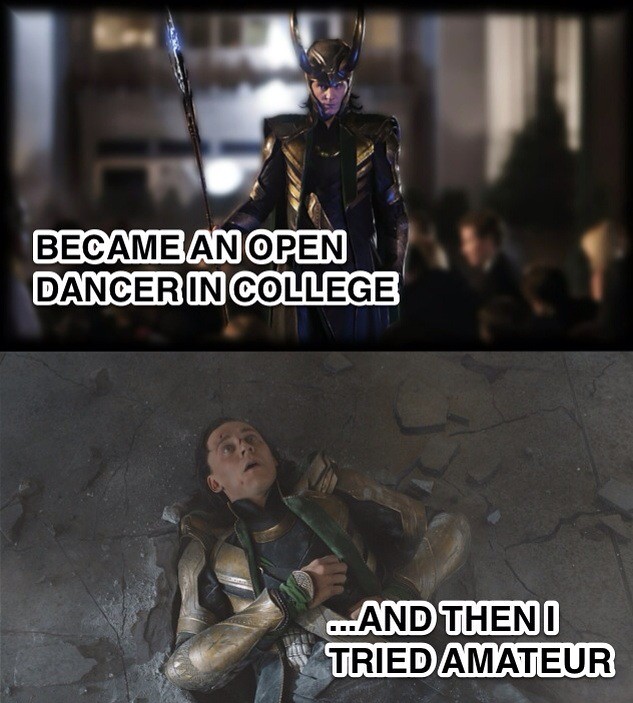 People in my town don't ballroom dance (Sorry, Grand Rapids, but most dancers out there don't even know what a Fallaway Reverse & Slip Pivot is...). Instead, people swing and people salsa. But when somebody gets a little crazy with the music and plays a waltz or a tango, the dance floor becomes my home court. I still have a good time (typically), but it's tough to really enjoy a waltz when everybody is box-stepping off time and against the line of dance. Yeah, I get my choice of partner, and a little recognition, but it would be nicer to dance a respectable natural turn uninterrupted.
Big fish, small pond - it's a give and take.
So, I started travelling. I moved to a bigger pond. There, I found more people that actually enjoyed ballroom dancing the way I did. And then there's the whole culture of the collegiate competition circuit - if you want to get better, work harder and dance more. And everybody is coming pretty much from the same place:
I'm in college for 3-6 years, and I want to learn something that's new and fun.
So sure, people develop tastes - some people get obsessed and become great quickly; others chill in Bronze and compete on weekends that they and their partner are free. And despite the wide spectrum of personalities and goals ("I just want to meet girls", "I need an excuse to exercise", "this is fun and I'll do it my whole life", etc.), there's still a pretty universal camaraderie among the college crowd.
- Sure, let's have an afterparty.
- Check out this video on youtube.
- Let's all go to the social.
- Let's all do a fundraiser.
- Let's carpool and then crash on a couch.
- Let's reserve the studio from 10 pm to 12 am then get a drink afterwards.
But
- and I never though that I, of all people, would ever say this -
what if it's a little too much fun?
Ok, imma have to explain that one. I mean, what if somebody wanted to get a little more...serious about dancing? What if ballroom dance became more than a hobby or pastime, and became more of a lifestyle? What if that's not a means to an end - when the switch happens from:
| "Oh, I'll learn how to dance in order to meet people." | -to- | "I only want to meet people who dance." |
OR
| ||
| "My partner isn't free tonight. Guess I'll play a video game/go to the pub/watch a movie." | -to- | "My partner isn't free tonight. Guess I'll go practice alone/find somebody else/watch pros on youtube." |
I may not be quite so crazy as that, but I'm getting there. I feel like a clingy boyfriend, and ballroom dance is my girl. I spend all my money on dance, I think about dancing throughout the day, when I am forced to take a break from dance (sprained ankle, etc), I still try to show up at places where I know where ballroom dance will be and "accidentally run into" it, and try to gauge if ballroom misses me as much as I miss it.
....kinda sad how accurate that last paragraph was....
More to the point, I was wondering if there was anybody else in the college pond who wanted to treat ballroom dance as more than a friend.
If you look at the general flow of the volume of ballroom of dancers, it will go something like this. Let's say there is a competition with 100 competing couples (remembering couples can dance two levels):
- 35 will dance Newcomer
- 50 will dance Bronze
- 30 will dance Silver
- 15 will dance Gold
- 8 will dance Novice
- 3 will dance Prechamp
- Every once in a while, there may be 1-2 couples that make it to Champ
Well, for one, the "while I'm in college" constraint typically makes it difficult for college couples to get to champ - unless you start in Freshman Undergrad and stay through your masters (or you're Alex Rowan), it'll be tough to go the distance in the allotted time. But even then, the steady stream of open dancers seems to trickle off rather rapidly...but why? Where do they all go?
They go to the a bigger pond - the Adult Amateur category.
Imagine, instead of the pyramidic picture I painted of how dancers struggle to make it to the top, there are more people in Champ than Novice because they've won Prechamp too many times and it would now be cherry-picking. Yeah. Imagine walking into the ballroom and out of the several hundred dancers there, only about 5% are wearing dresses that cost less than $1K. Earlier this year, I danced a prechamp standard round at Michcomp - ONE guy wore a tailsuit. At the MAC in January, I was one of 2 or 3 out of 40 that DIDN'T wear tails. But the wardrobe and distribution wasn't even the most jarring difference.
It was the chins.
[the wha...?]
THE CHINS. STUCK IN THE AIR, NO LOOKING DOWN.
Everybody had their head held high, dancing or not. And nobody talked to anyone other than their partners and coaches, save for the few sets of college "teams" (meaning 4-5 couples out of a team of 50+) that came as a group. Everyone was there on business - "this is the result of the work I have done. I am here to dance my best, and hopefully it's enough to get me into nationals. I am here for the dancing and for the ribbon." And that was it. No "dude, let's chill," or "can you teach me that," or anything like that. It was all....COLD. Oh, sure, a few "I love your dress" comments, and a couple "You guys were great" compliments, and the occasional, "Oh! I haven't seen you since X!" introduction. But mostly, people came alone and kept to themselves.
AND I LOVED IT.
[To be fair, I was getting plenty of unorthodox attention from the Ballroom Addict video]
But everybody was in the zone the whole weekend. And as much as I tried to behave, I still ended up losing my cool and nerding out, simply because here are people that "GET IT". That joke about Fallaway Reverse and Slip Pivot? Everybody gets it - they all went through it. Punchline about a line figure? It's now funny.
Since then, I've mostly stuck to the bigger pond. I'm sure there are more out there. My partner and I are just starting to dance Champ - I imagine we're in for a bit of a culture shock. I wonder what the differences are between the amateur, pro-am, and professional scenes? I suppose there's a newfound respect for higher level dancers. Nobody "gets lucky" anymore - with the exception of some politics, everyone is exactly as good as the work they've put in. And I'm excited to see how my work stack up.
But for now, CHINS.
Wednesday, October 17, 2012
Jogging might be a better idea than dance practice
I like getting better. At anything. Who doesn't? Whether I'm getting faster at my job, or ranking up in a video game, or parallel parking like a boss, it feels good to improve.
This is especially true when the task is competitive in nature. When you are working toward a goal, testing your progress against others with the same goal is the only true measure of your progress. The thing is, it doesn't necessarily come down to your effort versus my effort - if it were that simple, skill could be quantified in hours, and we might as well go home as soon as we're up against someone who's been doing our task a little longer. It's also about knowing what to practice, where to get help, and how to respond to successes and failures along the way.
Dancing is no exception. And I suppose I'm mostly speaking in terms of competitive dancers, though I've met a few rather serious social dancers. Like anything else, you get back what you put in - however, "what you put in" refers to more than just time and energy. If you practice 10 hours a week, trying to duplicate what professionals are doing on YouTube, you will look like a dancer who spends 10 hours a week practicing what they saw on YouTube. If you take 3 hours of lessons with world-class coaches, practice on your own for 3 hours drilling basics, and only frame up with your parter for 3 hours to talk about connection and to dance rounds, you will look like a dancer who...well, you get the idea. 10 hours of unfocussed effort is not going to give you the same result as 9 hours of effective training.
However, where that focus goes is a tough question. I seem to come across two different schools of thought when it comes to practicing ballroom dancing, though I'm sure it translates to other skills.
First, I meet dancers that are focused on impressing. Flashier moves. Bigger shapes. More difficult footwork. Have a couple of amazing moments, and they're sure to want more. I used to belong to this group - gotta have a few go-to steps I could do well, and spam 'em. Focus on the strengths, and play to them. I have trouble with shapes? Then I'll do faster moves. My footwork is poor? I'll do the easier steps and more lines.
Thing is, there's only so much you can do like this before it catches up to you. Sorry, but the biggest frame in prechamp standard will probably get smoked if they're taking bronze-sized steps.
Second, there are the dancers that are attached to the cleanup. Learn every step in every syllabus. Learn all of the technique on this figure before moving on. "I have one section that doesn't feel right - let's work on it until it feels right." This route requires patience, but ends up being very rewarding in the long run. The hard stuff is easy once you've got the basic down solid.
And yet, where's the fun in that? And what if the problem you're stopping to fix isn't really the root cause?
I belonged to this group at one point as well. I spent weeks "fixing" my frame to make a single section of one routine feel a little smoother, only to find out much later that my footwork was wrong, making it nearly impossible to step without distorting myself (and my partner). Quick fix on the placement, and it was all good in the frame. And all that time was wasted - anything that I had improved upon was overshadowed by the time it took to get out of the bad-footwork habit I was solidifying.
Now I certainly can't suggests that either of these routes is the way to go - as you probably guessed, I prefer a mix of the two. In competition, you may only get a judge's attention for 3 seconds, and you need to make sure that you don't give them a reason not to mark you. You have to keep things clean. But just being clean isn't enough to make you stand out - you need to keep learning new concepts as well. In fact, sometimes the new stuff inadvertently fixes the problem spots - I had a big problem with timing in the Slow Foxtrot, but learning better swing helped fix that little mess.
Bottom line, if you show up to practice just to power-through your choreography 10 times, you might as well do it once and go jogging instead. Because unless you're actively working on something, then you're only doing you and your a partner a favor on the memory/endurance side. Instead, try fixing a bad habit you've internalized, or adding some technique you've learned but haven't internalized yet.
And remember, like most skills, identifying what to do next is easier with professional help. And knowing is half the battle.
Wednesday, October 3, 2012
Sunday, September 23, 2012
Expressing Oneself - Huh?
I never understood the phrase "expressing oneself" through an artform, until just recently.
But I think I have an idea now.
Dancing is like any other form of communication, like a second language. When learning the basics, one does nothing more than communicate, 'I am capable of doing the basics.' But as understanding of the language increase, so does one's ability to express themselves more clearly in the language.
 And it is appreciated more by those who can understand the language. Maybe this is why the "Dancing With the Stars" phrase comes off a bit insulting? Not out of elitism (well, maybe a bit), but from the part of us that wants to be known and understood. Nothing wrong with the show - just dancers with very different intentions than us outside of professional showbiz.
Maybe that's why I like International Waltz so much. If you've hung out with me, you know my voice and overall demeanor reflect "Jive".
Perhaps I have a hard time expressing "Waltz" in English?
But I think I have an idea now.
Dancing is like any other form of communication, like a second language. When learning the basics, one does nothing more than communicate, 'I am capable of doing the basics.' But as understanding of the language increase, so does one's ability to express themselves more clearly in the language.

Maybe that's why I like International Waltz so much. If you've hung out with me, you know my voice and overall demeanor reflect "Jive".
Perhaps I have a hard time expressing "Waltz" in English?
Subscribe to:
Posts (Atom)